Chapter 1: Basic Concepts and Models
(AST305) Lifetime Data Analysis I
1.1 Introduction
Lifetime Data
Lifetime data describe the time until a particular event occurs.
-
The event may be:
- death of a patient;
- failure of a machine;
- recurrence of a disease;
- divorce or dissolution of a marriage;
- appearance of a tumor.
-
Lifetime data are important in:
- health and medical sciences;
- engineering and reliability;
- social and behavioral sciences;
- economics and business.
Other Names
Lifetime data are also called:
- survival-time data;
- failure-time data;
- event-time data;
- time-to-event data.
The preferred term often depends on the field of application.
For example:
- In medicine, we often use survival time.
- In engineering, we often use failure time.
- More generally, we use time to event.
Example 1.1.1 – Engineering
Manufactured items, such as mechanical or electronic components, are often tested for durability.
The items are operated under controlled conditions and observed until they fail.
The recorded lifetimes are usually called failure times.
Possible event: breakdown of an electrical component.
Possible time unit: hours of operation.
Example 1.1.3 – Medical Studies
For patients with potentially fatal diseases, an important outcome is survival time.
-
Survival time may be measured from:
- diagnosis;
- the beginning of treatment;
- randomization in a clinical trial.
Treatments may be compared using the distributions of patients’ survival times.
Example 1.1.4 – Laboratory Experiments
In carcinogenicity studies, laboratory animals may be exposed to particular substances.
The animals are then followed until tumors appear.
The main outcome is the time to tumor appearance.
Here, the event is not necessarily death. It is the occurrence of a tumor.
Defining Lifetime: Three Basic Elements
A lifetime variable must be defined using three elements:
- a time origin;
- a time scale;
- an event of interest.
For example, in a cancer study:
- Time origin: date of diagnosis;
- Time scale: months since diagnosis;
- Event: death.
Event of Interest
The event of interest is the outcome that ends the observed lifetime.
Examples include:
- death;
- machine failure;
- disease recurrence;
- hospital discharge;
- recovery;
- divorce;
- first purchase by a customer.
The event must be defined clearly before the analysis begins.
Time Origin
The time origin is the zero point from which lifetime is measured for an individual.
It marks the beginning of the individual’s follow-up.
Common examples include:
- date of diagnosis;
- date of randomization;
- date treatment begins;
- date of recruitment;
- date a machine starts operating.
Important Features
The time origin must be clearly defined.
It should have the same meaning for all individuals.
Calendar dates may differ across individuals.
Individuals may enter a study at different times. This is called staggered or rolling entry.
For example, patients may be recruited continuously over a two-year period.
Illustration
Suppose two patients enter a clinical trial on different dates:
| Patient | Date of entry | Date of event | Survival time |
|---|---|---|---|
| A | 1 January | 1 April | 3 months |
| B | 1 March | 1 June | 3 months |
Although the calendar dates differ, both patients have the same observed survival time.
Time Scale
The time scale determines how lifetime is measured from the time origin.
Common chronological time scales include:
- seconds;
- minutes;
- hours;
- days;
- months;
- years.
The choice of time scale should be scientifically meaningful.
Common Time Scales
Time since study entry
- Measures the duration of follow-up.
- Example: months since randomization.
Attained age
- Uses the individual’s actual age as the time scale.
- Example: the event occurs when a participant reaches age 68.
Calendar time
- Uses actual calendar dates.
- This may be useful when risks change over historical periods.
Non-chronological Time Scales
Lifetime need not always be measured using clock or calendar time.
Examples include:
- kilometers or miles driven before a vehicle breaks down;
- number of pages printed before a printer fails;
- number of production cycles before a component fails;
- number of transactions before a customer closes an account.
The important idea is the amount of exposure before the event.
Censoring
In practice, the complete lifetime may not be observed for every individual.
Possible reasons include:
- the study ends before the event occurs;
- a participant withdraws;
- a participant is lost to follow-up;
- a machine is still operating when the experiment stops.
Such incomplete observations are called censored observations.
Ignoring censored observations can produce biased or misleading conclusions.
Suppose a life test stops after 28 days.
If an item fails on day 20, its exact failure time is known.
If an item is still operating on day 28, its exact failure time is unknown.
We only know that its lifetime is:
\[ T > 28. \]
This is a right-censored observation.
For each individual, we commonly record:
\[ Y = \min(T,C), \]
where:
- \(T\) is the true lifetime;
- \(C\) is the censoring time;
- \(Y\) is the observed time.
We also record the event indicator:
\[ \delta = \begin{cases} 1, & \text{if the event is observed},\\ 0, & \text{if the observation is censored}. \end{cases} \]
Simple Illustration
| Subject | True status | Observed time | \(\delta\) |
|---|---|---|---|
| A | Event at 12 months | 12 | 1 |
| B | Study ends at 15 months | 15 | 0 |
| C | Lost after 8 months | 8 | 0 |
For Subjects B and C, the exact event times are unknown.
Types of Censoring
The three main types are:
- right censoring;
- left censoring;
- interval censoring.
These will be discussed in more detail in the next chapter.
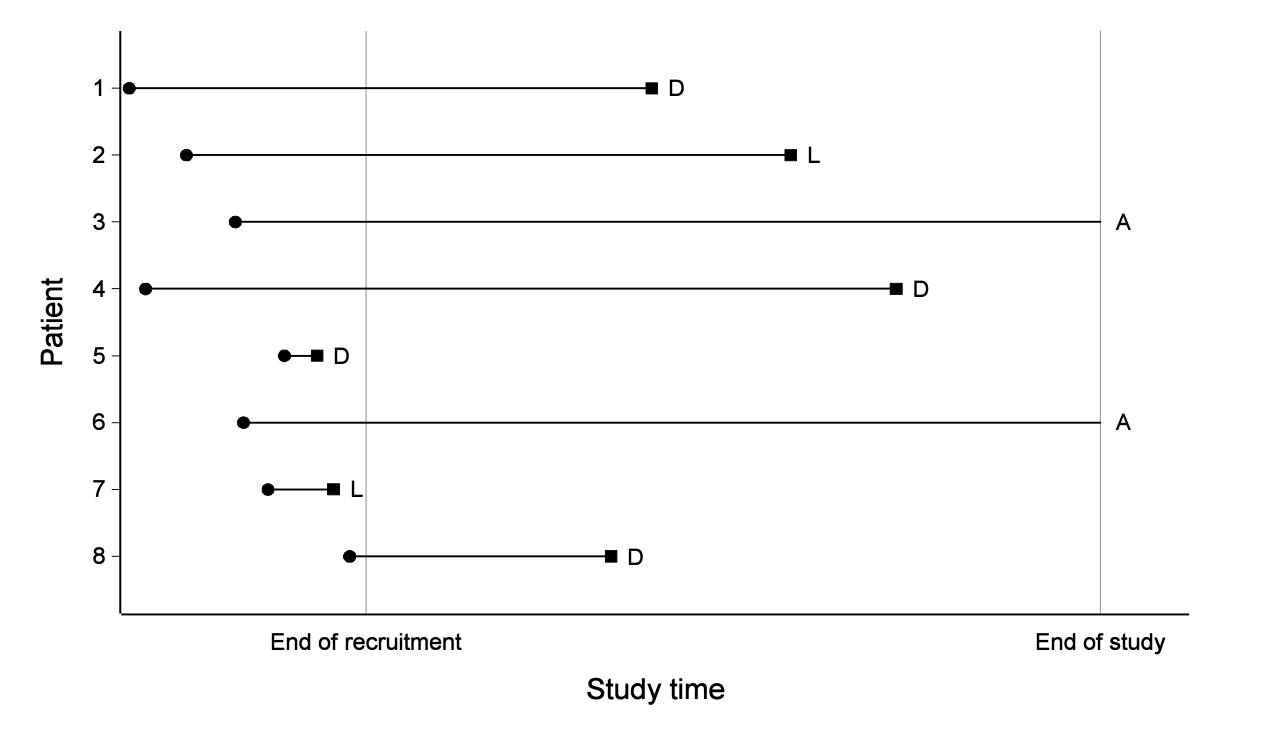
Censoring in a Survival Study
Interpreting the Diagram
A line represents the follow-up period of a subject.
D indicates that death was observed.
L indicates that the subject was lost to follow-up.
A indicates that the subject was alive when the study ended.
Subjects marked L or A have right-censored survival times.
Example 1.1.5 – Electrical Insulating Fluid
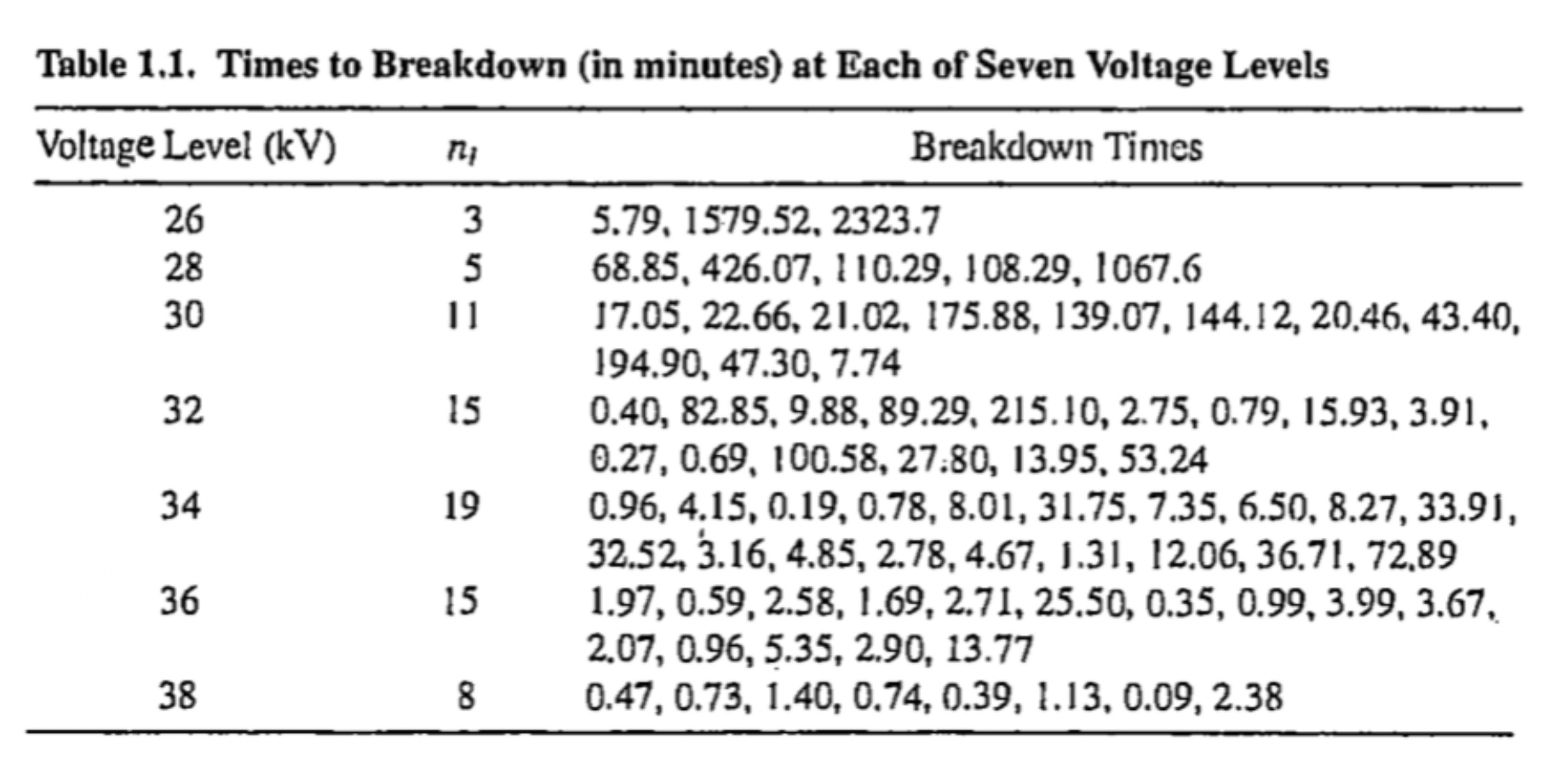
Nelson (1972) studied electrical insulating fluid under constant voltage stress.
The outcome was the time until electrical breakdown.
Specimens were tested at voltages ranging from 26 to 38 kV.
The recorded times are failure times.
Example 1.1.5 – Electrical Insulating Fluid
Example 1.1.5 – Main Finding
The data suggest that:
\[ \text{higher voltage} \quad \longrightarrow \quad \text{shorter breakdown time}. \]
Thus, increasing the voltage appears to accelerate the failure process.
Example 1.1.5 – Possible Censoring
Suppose the experiment had been stopped after 180 minutes.
Specimens that failed before 180 minutes would have exact failure times.
Specimens still operating at 180 minutes would be right-censored.
For a surviving specimen, we would only know that:
\[ T > 180 \text{ minutes}. \]
Example 1.1.7 – Clinical Trial (Leukemia)
Gehan (1965) compared 6-mercaptopurine (6-MP) with placebo among patients with acute leukemia.
The outcome was remission time.
Remission is a period during which the signs and symptoms of a disease decrease or disappear.
The disease may return later.
Example 1.1.7 – Study Design
-
The study included two treatment groups:
- 21 patients receiving placebo;
- 21 patients receiving 6-MP.
Remission time was measured until relapse.
Some patients remained in remission when their observation ended.
These patients had censored remission times.
Example 1.1.7 – Clinical Trial Data

Example 1.1.7 – Questions of Interest
The study raises several statistical questions:
Do patients receiving 6-MP remain in remission longer?
How should censored remission times be included?
How can the two survival distributions be compared?
How can treatment effects be summarized?
These are central questions in lifetime data analysis.
Exercise 1
Identify the time origin, time scale, event, and possible reason for censoring in each study.
Patients are followed from kidney transplantation until graft failure.
Mobile phones are tested from the beginning of continuous use until battery failure.
Married couples are followed from their wedding date until divorce.
University graduates are followed from graduation until their first full-time job.
Exercise 2
A study follows five patients for 12 months.
| Patient | Outcome |
|---|---|
| A | Died after 4 months |
| B | Alive after 12 months |
| C | Withdrew after 7 months |
| D | Died after 10 months |
| E | Alive after 12 months |
For each patient:
- report the observed time;
- determine whether the observation is censored;
- assign the event indicator \(\delta\).
1.2 Lifetime Distributions
Why Do We Need a Distribution?
Let \(T\) denote the lifetime of an individual or an item.
- \(T\) is usually a positive random variable.
- Its value is not known before the event occurs.
- A probability distribution describes how lifetimes vary in a population.
Examples of \(T\) include:
- time from diagnosis to death;
- operating time until a machine fails;
- time from treatment to disease recurrence;
- duration of a marriage.
Four Equivalent Descriptions
For a continuous lifetime \(T\), its distribution can be described using:
- the density function, \(f(t)\);
- the cumulative distribution function, \(F(t)\);
- the survivor function, \(S(t)\);
- the hazard function, \(h(t)\).
Knowing any one of these functions determines the other three.
Cumulative Distribution Function
The cumulative distribution function (CDF) is
\[ F(t)=\Pr(T\le t), \qquad t\ge 0. \]
For a continuous lifetime with density \(f(t)\),
\[ F(t)=\int_0^t f(x)\,dx. \]
Thus, \(F(t)\) is the probability that the event occurs by time \(t\).
Interpreting the CDF
Suppose
\[ F(12)=0.30. \]
Then 30% of individuals are expected to experience the event within 12 time units.
Depending on the study, this may mean:
- 30% of patients die within 12 months; or
- 30% of components fail within 12 hours.
Survivor Function
The survivor function is
\[ S(t)=\Pr(T>t). \]
For a continuous lifetime,
\[ S(t)=\int_t^\infty f(x)\,dx. \]
Therefore,
\[ S(t)=1-F(t). \]
In reliability engineering, \(S(t)\) is also called the reliability function.
Interpreting the Survivor Function
Suppose
\[ S(12)=0.70. \]
Then 70% of individuals are expected to survive beyond 12 time units.
Because \(F(t)+S(t)=1\),
\[ F(12)=1-S(12)=0.30. \]
Properties of the Survivor Function
For a positive, continuous lifetime:
- \(S(0)=1\);
- \(0\le S(t)\le 1\);
- \(S(t)\) is non-increasing;
- \(\displaystyle \lim_{t\to\infty}S(t)=0\).
A valid survivor curve starts at 1 and decreases toward 0.
Density in Terms of Survival
Since
\[ F(t)=1-S(t), \]
we have
\[ f(t)=\frac{d}{dt}F(t)=-\frac{d}{dt}S(t). \]
Thus, the density measures how quickly the survivor function is decreasing.
Mean Lifetime
For a nonnegative continuous lifetime,
\[ E(T)=\int_0^\infty S(t)\,dt, \]
provided the integral is finite.
Therefore, the mean lifetime is the area under the survivor curve.
Quantiles of a Lifetime Distribution
The \(p\)th quantile, denoted by \(t_p\), satisfies
\[ F(t_p)=p. \]
For a continuous distribution, this is equivalent to
\[ S(t_p)=1-p. \]
Hence,
\[ t_p=F^{-1}(p). \]
- \(t_p\) is the \(100p\)th percentile.
- \(t_{0.25}\) is the first quartile.
- \(t_{0.50}\) is the median lifetime.
- \(t_{0.75}\) is the third quartile.
The median lifetime satisfies
\[ S(t_{0.5})=0.5. \]
Mean Versus Median Lifetime
The mean and median answer different questions:
- Mean: the average lifetime in the population;
- Median: the time by which 50% experience the event.
Lifetime distributions are often right-skewed, so the mean may be much larger than the median.
Mortality and Hazard
In a life table, define
\[ q_t=\Pr(t\le T<t+1\mid T\ge t). \]
This is the probability of experiencing the event during \([t,t+1)\), among individuals event-free at time \(t\).
Because \(q_t\) is a probability,
\[ 0\le q_t\le 1. \]
It is often called a mortality probability or conditional failure probability.
Hazard Function
The hazard function is
\[ h(t)=\lim_{\Delta t\to0} \frac{\Pr(t\le T<t+\Delta t\mid T\ge t)}{\Delta t}. \]
For a continuous lifetime,
\[ h(t)=\frac{f(t)}{S(t)}. \]
It describes the instantaneous event rate at time \(t\), conditional on survival up to that time.
Hazard Is a Rate, Not a Probability
The hazard function:
- is nonnegative;
- is measured per unit of time;
- may be greater than 1;
- is not the probability of failure exactly at time \(t\).
For a very small interval \(\Delta t\),
\[ \Pr(t\le T<t+\Delta t\mid T\ge t) \approx h(t)\Delta t. \]
Units of the Hazard
The numerical value of a hazard depends on the time unit.
Suppose the conditional probability of failure over an interval is approximately \(1/4\), and the interval length is \(1/3\) day:
\[ h(t)\approx\frac{1/4}{1/3}=0.75 \text{ per day}. \]
The same interval is \(1/21\) week, so
\[ h(t)\approx\frac{1/4}{1/21}=5.25 \text{ per week}. \]
These are the same rate expressed in different units.
Interpreting Two Hazards
Suppose at time \(t\):
\[ h_A(t)=0.02 \text{ per month}, \qquad h_B(t)=0.05 \text{ per month}. \]
Individuals in Group B have the greater instantaneous event rate at that time.
However, a hazard value alone is not a probability. Over a short interval of 0.1 month,
\[ 0.05\times0.1=0.005 \]
is an approximate conditional event probability.
Other Names for the Hazard
Depending on the application, the hazard function is also called:
- the force of mortality;
- the instantaneous failure rate;
- the conditional failure rate;
- the intensity of failure.
Relationships Between Functions: Hazard in Terms of Survival
We know that
\[ f(t)=-S'(t). \]
Therefore,
\[ h(t)=\frac{f(t)}{S(t)} =-\frac{S'(t)}{S(t)} =-\frac{d}{dt}\log S(t). \]
This identity connects the hazard and survivor functions.
Survivor Function in Terms of Hazard
Starting from
\[ h(t)=-\frac{d}{dt}\log S(t), \]
integrate from 0 to \(t\):
\[ \int_0^t h(x)\,dx =-\left[\log S(t)-\log S(0)\right]. \]
Since \(S(0)=1\),
\[ S(t)=\exp\left[-\int_0^t h(x)\,dx\right]. \]
Cumulative Hazard Function
The cumulative hazard function is
\[ H(t)=\int_0^t h(x)\,dx. \]
It accumulates the hazard from time 0 to time \(t\).
The survivor function can be written as
\[ S(t)=\exp[-H(t)]. \]
Equivalently,
\[ H(t)=-\log S(t). \]
Properties of the Cumulative Hazard
For an ordinary lifetime distribution:
- \(H(0)=0\);
- \(H(t)\) is non-decreasing;
- \(H(t)\ge0\);
- \(\displaystyle H(t)\to\infty\) as \(t\to\infty\).
Unlike a probability, \(H(t)\) can exceed 1.
When Does the Cumulative Hazard Exceed 1?
Because
\[ H(t)=-\log S(t), \]
we have
\[ H(t)\ge1 \quad \Longleftrightarrow \quad S(t)\le e^{-1} \approx 0.368. \]
Thus, the cumulative hazard exceeds 1 when the probability of surviving beyond \(t\) is at most about 0.368.
Comparing Two Lifetime Distributions
Suppose two groups satisfy
\[ h_1(t)\ge h_2(t) \quad\text{for every }t\ge0. \]
Then
\[ H_1(t)\ge H_2(t) \quad\text{and}\quad S_1(t)\le S_2(t). \]
If both means exist, Group 1 also has no greater mean lifetime than Group 2.
The comparison must hold over time; comparing hazards at only one time point is not enough.
Density in Terms of Hazard
Because \(f(t)=h(t)S(t)\),
\[ f(t)=h(t) \exp\left[-\int_0^t h(x)\,dx\right]. \]
Therefore, specifying the hazard function completely determines the lifetime distribution.
Summary of the Relationships
\[ \begin{aligned} F(t)&=1-S(t),\\ f(t)&=F'(t)=-S'(t),\\ h(t)&=\frac{f(t)}{S(t)},\\ H(t)&=\int_0^t h(x)\,dx=-\log S(t),\\ S(t)&=e^{-H(t)},\\ f(t)&=h(t)e^{-H(t)}. \end{aligned} \]
Example 1.2.1
Suppose \(T\) has probability density function
\[ f(t)=\beta t^{\beta-1}\exp(-t^\beta), \qquad t>0, \]
where \(\beta>0\).
Obtain:
- the survivor function of \(T\);
- the hazard function of \(T\).
Discrete Models: Motivation
- Sometimes lifetimes are measured in cycles or intervals (e.g., weeks, months, visits).
- Then \(T\) is a discrete random variable.
- Possible values: \(t_1, t_2, \dots\), with \(0 = t_0 < t_1 < t_2 < \cdots\).
Discrete Probability Functions
Probability mass function (pmf): \[ f(t_j) = \Pr(T = t_j), \quad j=1,2,\dots \]
Survivor function: \[ S(t) = \Pr(T \geq t) = \sum_{j: t_j \geq t} f(t_j) \]
-
Properties:
- Step function (non-increasing).
- Left-continuous.
- \(S(0)=1,\; S(\infty)=0\).
Note: In continuous-time settings we often write \(S(t)=\Pr(T>t)\) (right-continuous); here, with discrete times, \(S(t)=\Pr(T\ge t)\) is left-continuous.
Discrete Hazard Function
- Defined as \[ h(t_j) = \Pr(T = t_j \mid T \geq t_j) = \frac{f(t_j)}{S(t_j)}. \]
- Interpretation: probability of failing at time \(t_j\) given survival up to that time.
- Range: \(0 \leq h(t_j) \leq 1\).
- Unlike continuous hazard, this is a probability, not rate.
- Connection to survivor:
\[ h(t_j) = 1 - \frac{S(t_{j+1})}{S(t_j)}. \]
since \(f(t_j) = S(t_j) - S(t_{j+1})\)
Survivor in terms of hazards:
\[ S(t) = \prod_{t_j < t} [1 - h(t_j)]. \]
Intuition
To survive until \(t_j\): must “not fail” at earlier times \([1-h(t_1)], [1-h(t_2)], \dots, [1-h(t_{j-1})]\).
- pmf in terms of hazards:
\[ f(t_j) = h(t_j) \prod_{i=1}^{j-1} [1 - h(t_i)]. \]
Intuition
To fail exactly at \(t_j\): multiply survival so far by hazard at \(t_j\).
Some Remarks on Hazard Functions
The hazard function is an important characteristic of a lifetime distribution that indicates the way the risk of failure varies with age or time, and this is of interest in most applications.
In many instances, information is available on how failure rates change with time and such prior information about the shape of the hazard function can help guide model selection.
The model/information for hazard function can easily be translated for survivor and density functions using the formulas derived earlier
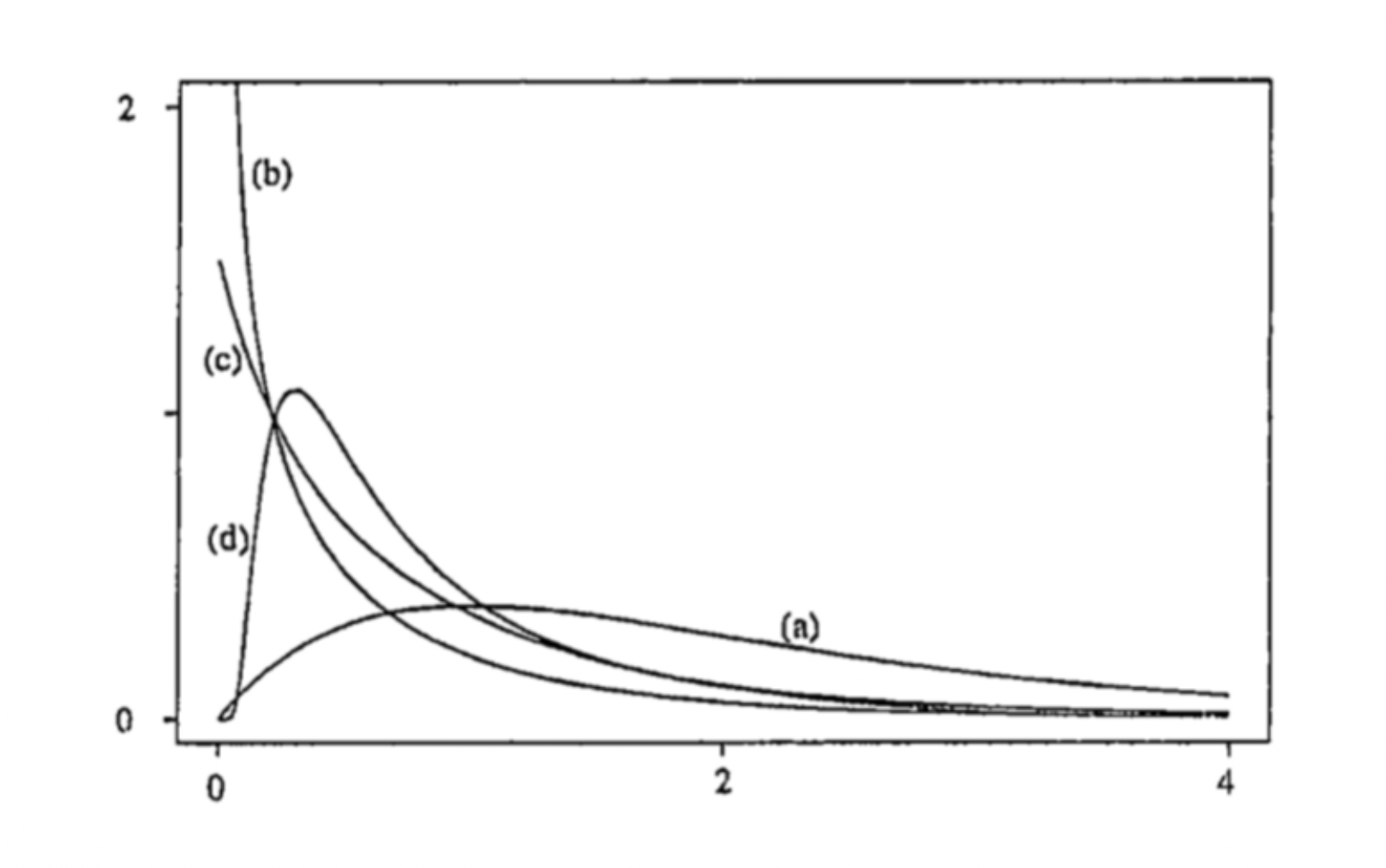
Different Shapes of Hazard Functions
-
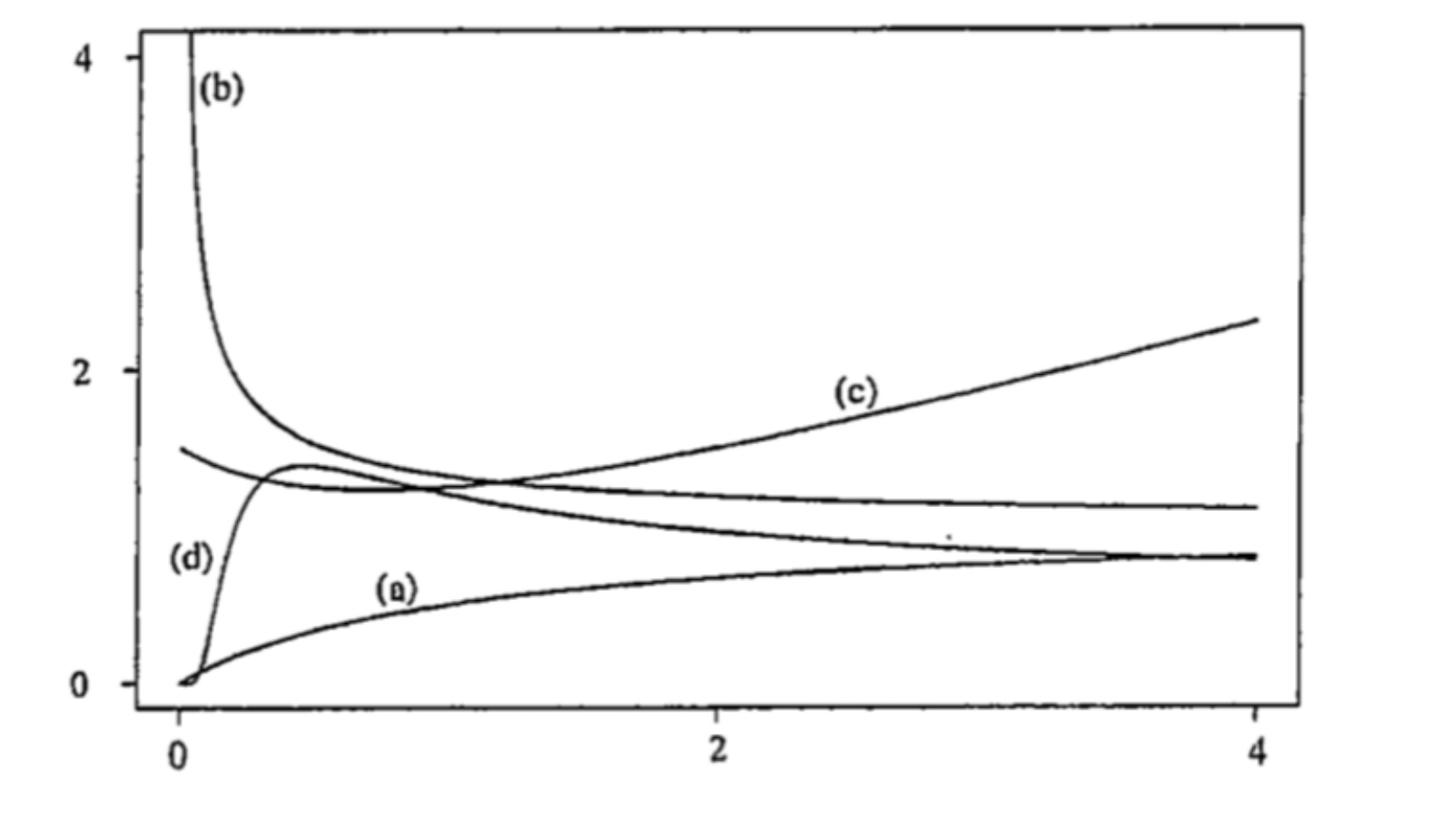
The shapes of hazard functions could be different, such as
monotone increasing (e.g. positive aging)
(a)monotone decreasing (e.g. negative aging)
(b)bathtub-shaped or U-shaped (e.g. age at death of human populations, lifetime of manufactured items, etc.)
(c)inverse bathtub-shaped (e.g. survival after treatment for cancer, duration of marriage, etc.)
(d)
Different Shapes of Density Functions
Some Remarks on Hazard Functions
Shapes of density function could be different corresponding to the shapes of hazard functions
Although different survivor functions can have the same basic shape, their hazard functions can differ dramatically
The hazard function is usually more informative about the underlying mechanism of failure than the survivor function.
Modelling the hazard function is an important method for summarizing survival data
1.3 Some Important Failure Time Models
Introduction
In survival analysis, parametric models are often used to describe lifetime data.
Only a few distributions have proven useful across many applications.
-
The most common univariate models are:
- Exponential
- Weibull
- Log-normal
- Log-logistic
- Exponential
-
Notations
\(T\,\rightarrow\) lifetime, takes only nonnegative values, i.e. from 0 to \(\infty\)
\(Y = \log T\,\rightarrow\) log-lifetime, takes any value on the real line, i.e. from \(-\infty\) to \(\infty\)
The Exponential Distribution
-
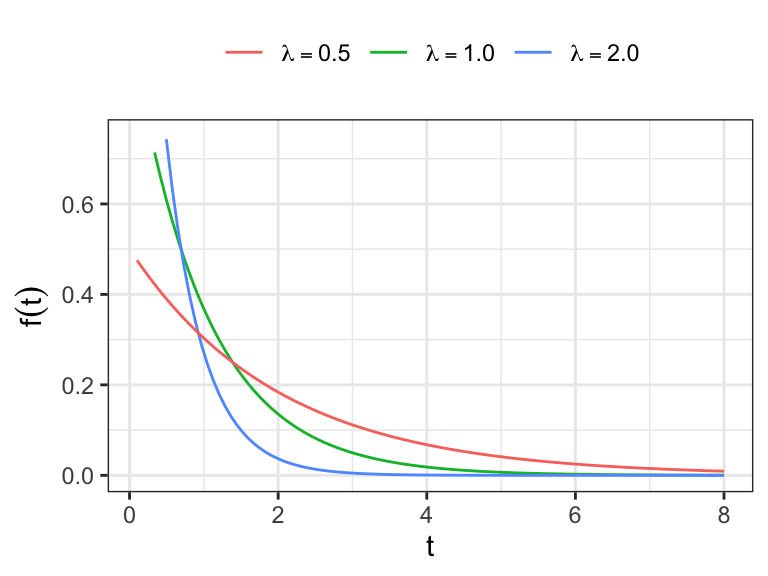
The exponential distribution is characterized by a constant hazard function \[h(t) = \lambda, \;t\geq 0 \]
- \(\lambda >0\)
The cumulative hazard function \[ H(t) = \int_0^t h(x)\,dx = \int_0^t \lambda\,dx = \lambda t \]
The survivor function \[ \begin{aligned} S(t) &= \exp(- H(t)) \\ & = \exp(-\lambda t) \end{aligned} \]
The probability density function \[ \begin{aligned} f(t) & = {\color{red} h(t)}\,{\color{blue} S(t)} = {\color{red}\lambda}\,{\color{blue}\exp(-\lambda t)} \end{aligned} \]
Reparameterization \(\theta = \lambda^{-1}\) Then, \(T\sim \text{Exp}(\text{scale}=\theta)\), where
\[ f(t) = (1/\theta)\,\exp(-t/\theta), \;\;t\geq 0 \]
-
Properties
\(E(T) = \theta\)
\(V(T) = \theta^2\)
-
Quantiles, the \(p\)th quantile \[ \begin{aligned} F(t_p) = p & \;\Rightarrow \;1 - \exp(-t_p/\theta) = p \; \\ & \; \Rightarrow {\color{purple} t_p = -\theta \log(1-p)} \end{aligned} \]
- The median, \(.5th\) quantile \[ t_{.5} = -\theta\log(.5) \]
The exponential distribution with \(\theta = 1\) is known as standard exponential distribution
-
If \(T\sim \text{Exp}(\theta)\) then \[ (T/\theta)\sim \text{Exp}(1) \]
The mean and variance of \(\text{Exp}(1)\) is 1
The median of the \(\text{Exp}(1)\) is \(-\log(.5)=0.6931\)
The density function of \(\text{Exp}(1)\) is positively skewed
-
Historically, the exponential was the first widely discussed lifetime distribution model
- This was in part because of the availability of simple statistical methods for it
The assumption of a constant hazard function is very restrictive, so the model’s applicability is fairly limited
The Weibull Distribution
The Weibull distribution is the most widely used lifetime distribution model.
-
It has applications to the lifetimes or durability of manufactured
- It is used as a model with diverse types of items, such as ball bearings, automobile components, and electrical insulation.
It is also used in biological and medical applications, for example, in studies on the time to the occurrence of tumors in human populations or in laboratory animals.
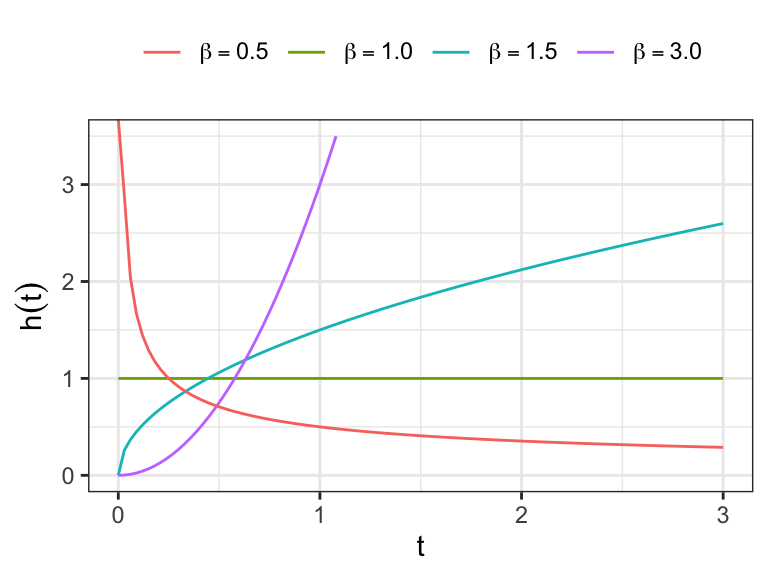
The hazard function of Weibull distribution \[ h(t)=\lambda\beta(\lambda t)^{\beta-1},\;\lambda>0,\;\beta>0. \]
-
Show that \(h(t)\) is
monotone increasing for \(\beta>1\)
monotone decreasing for \(\beta<1\)
constant for \(\beta=1\)
-
Exponential distribution is a special case
- For \(\beta=1\), Weibull distribution reduces to exponential distribution with \(h(t)=\lambda\)
The cumulative hazard function \[ H(t)=\int_0^t \,h(x)\,dx= \int_0^t \lambda\beta\, (\lambda x)^{\beta-1}\,dx=(\lambda\,t)^{\beta} \]
The survivor function \[ S(t) = \exp[-H(t)] = \exp[-(\lambda t)^\beta] \]
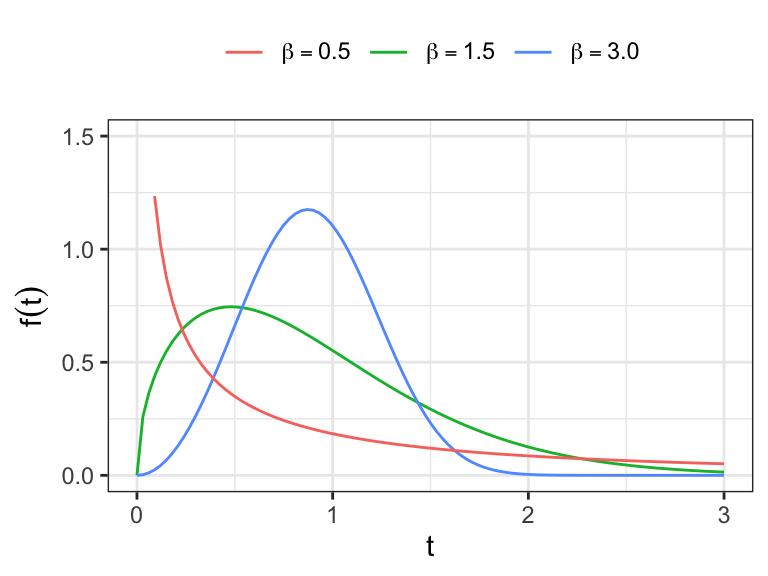
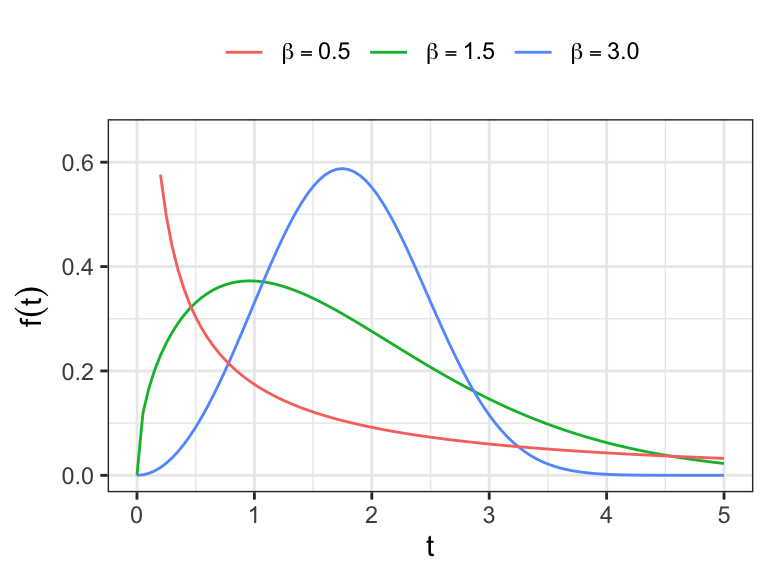
The density function \[ f(t) = h(t)\, S(t) = \lambda\beta\, (\lambda t)^{\beta-1}\exp[-(\lambda t)^\beta] \]
-
Show that the \(r^\text{th}\) moment of Weibull distribution \[E(T^r) = \lambda^{-r}\Gamma{(1 + r/\beta)}\]
- Obtain the expressions of \(E(T)\) and \(V(T)\)
-
The \(p^{\text{th}}\) quantile can be obtained as \[ \begin{aligned} F(t) &= 1-e^{-(\lambda t_p)^{\beta}}=p \\ \Rightarrow\ t_p & =\alpha[-\log(1-p)]^{1/\beta}, \qquad \text{where} \,\, \alpha=1/\lambda \end{aligned} \]
\(\alpha = 1/\lambda\) is known as the scale parameter of the distribution
The shape of the distribution depends on \(\beta\), which is known as the shape parameter
-
It can be shown that \(\alpha\) is the .632 quantile of the distribution irrespective of the value of \(\beta\)
- i.e. \(\alpha\) is greater than the median of the distribution!
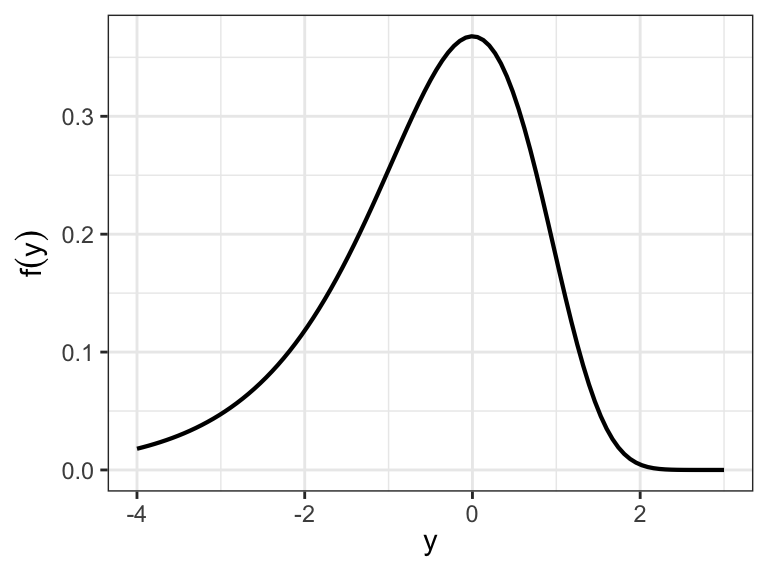
The Extreme Value Distribution
Let \(T\) follows a Weibull distribution \[ T\sim \text{Weib}(\alpha, \beta)\;\;\text{with}\;\; \alpha = 1/\lambda \]
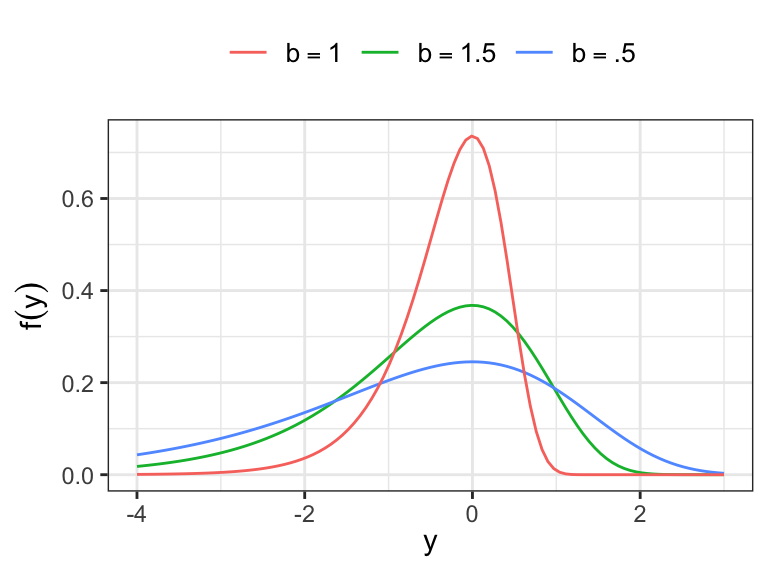
Extreme value distribution (also known as Gumbel distribution) is closely related to Weibull distribution
If lifetime \(T\) follows a Weibull distribution then log-lifetime \(Y = \log T\) follows an extreme value distribution
Extreme value distribution has two parameters, which have one-to-one connection with the Weibull distribution parameters!
-
Exercise: If \(T\sim \text{Weib}(\alpha, \beta)\), obtain the pdf of \(Y=\log T\)
- Hints. \(J = \frac{dt}{dy} = e^y\) and \[ f_Y(y) = f_T(e^y)\;\vert\, J\,\vert \]
-
\(T \sim \text{Weib}(\alpha, \beta)\;\;\Leftrightarrow\;\;Y = \log T\sim \text{EV}(u, b)\)
\(u = \log\alpha\) and
\(b = (1/\beta)\)
-
The pdf of \(Y\) \[ f(y) = (1/b)\exp\Big[\frac{y-u}{b}-\exp\Big(\frac{y-u}{b}\Big) \Big]\;\;-\infty< y <\infty \]
- \(-\infty < u < \infty\) and \(b>0\)
The survivor function \[ \begin{aligned} S(y) &= \int_y^{\infty} f(x) \,dx \\ & = \int_y^{\infty} (1/b)\exp\Big[\frac{x-u}{b}-\exp\Big(\frac{x-u}{b}\Big) \Big]\,dx \\ & = \exp\Big[-\exp\Big(\frac{y - u}{b}\Big)\Big] \end{aligned} \]
The cumulative hazard function \[ H(y) = \exp\Big(\frac{y-u}{b}\Big) \]
The hazard function \[ h(y) = \frac{d\,H(y)}{dy} = (1/b)\exp\Big(\frac{y-u}{b}\Big) \]
Standard extreme value distribution
- If \(Y\sim \text{EV}(u, b)\), then \[ \frac{Y-u}{b} \sim \text{EV}(0, 1), \] the standard extreme value distribution.
- The moment generating function of \(EV(u, b)\) \[ \begin{aligned} M_Y(\theta) = E[e^{\theta Y}] &= \int_{-\infty}^\infty e^{\theta y} \,f(y)\, dy\\ & = \int_{-\infty}^\infty e^{\theta y}\,(1/b)\,\exp\Big[\frac{y-u}{b} - \exp\Big(\frac{y-u}{b}\Big)\Big]dy \end{aligned} \]
\[ = \int_{-\infty}^\infty e^{\theta(u + bz)}\exp\big[z - \exp(z)\big]dz \qquad [ \text{let} \,\,\, \frac{y-u}{b} = z] \]
\[ = \int_0^\infty e^{\theta u}\, x^{\theta b}\, e^{-x}\, dx = e^{\theta u}\,\Gamma{(\theta b + 1)}, \qquad [\text{let} \,\,\, e^z =x] \]
If \(Y\sim EV(u, b)\) \[ M(\theta) = e^{\theta u}\, \Gamma(\theta b + 1) \]
If \(Y\sim EV(0, 1)\) \[ M(\theta) = \Gamma(\theta + 1) \]
Moments of standard extreme value distribution \(Z\sim EV(0, 1)\) \[ \begin{aligned} E(Z) &= \frac{d}{d\theta}M(\theta)\big\vert_{\theta=0}=\Gamma'(1)=-\gamma\;\; (\text{Euler's constant})\\ V(Z) & = \Gamma''(1) - \gamma^2 = \pi^2/6 \end{aligned} \]
For \(Y \sim EV(u, b)\), show that \[ E(Y) =u - \gamma b\;\;\text{and}\;\; V(Y) = b^2(\pi^2/6) \]
The \(p^\text{th}\) quantile of extreme value distribution
\[ \begin{aligned} F(y_p) & = p \\ S(y_p) &= 1-p \\ \exp\Big[-\exp\Big(\frac{y_p-u}{b}\Big) \Big] &= (1-p)\\ %\frac{y_p-u}{b} & = \log\big[-\log(1-p)] \\ y_p & = u + b\log\big[-\log(1-p)] \end{aligned} \]
- Show that the location parameter \(u\) is the .632 quantile of \(Y\sim EV(u, b)\)
The Log-normal Distribution
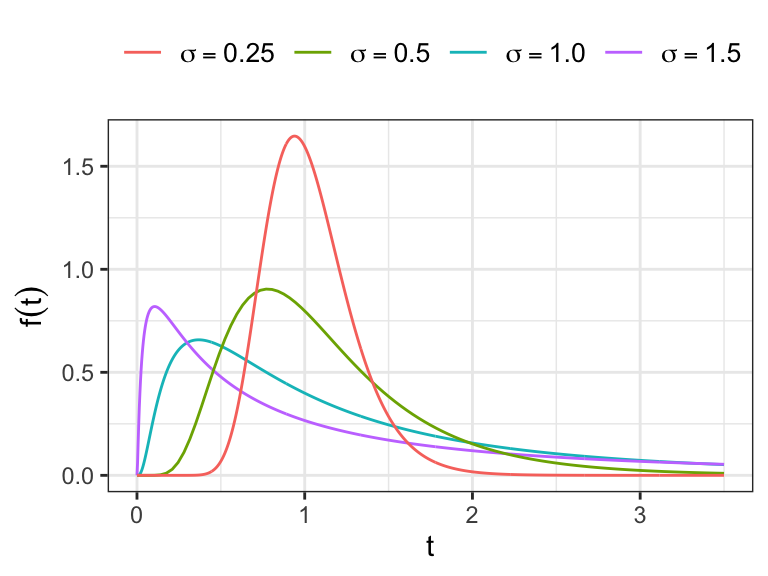
The lifetime \(T\) is said to be log-normally distributed if log-lifetime \(Y=\log T\) is normally distributed.
The parameters of normal distribution \(\mu\) and \(\sigma\) are also considered as the parameters of log-normal distribution \[ \begin{aligned} Y &=\log T \sim N(\mu, \sigma^2) \\ \Rightarrow\; T &= \exp(Y)\sim \log N(\mu, \sigma^2) \end{aligned} \]
- Let \(Y=\log T \sim N(\mu, \sigma^2)\), show that the density function of \(T=\exp(Y)\) is \[
\begin{aligned}
f_T(t) &= f_Y(\log T) \bigg\vert \frac{dy}{dt}\bigg\vert \\
& = \frac{1}{\sigma t\sqrt{2\pi}}\exp\Bigg[-\frac{1}{2}\Bigg(\frac{\log t - \mu}{\sigma}\Bigg)^2 \Bigg]
\end{aligned}
\]
- \(t>0\), \(\sigma>0\), and \(-\infty < \mu < \infty\)
-
The survivor function of \(T=\exp(Y)\) \[ S(t) = 1 - \Phi\bigg(\frac{\log t - \mu}{\sigma}\bigg) \]
- \(\Phi(\cdot)\;\rightarrow\) distribution function of \(N(0, 1)\)
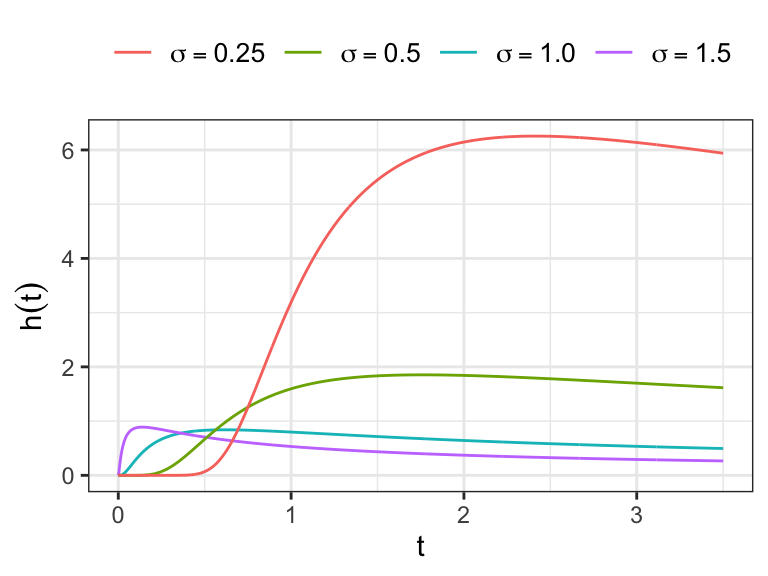
The hazard function is defined as \(f(t)/S(t)\), which takes the value 0 at \(t=0\), increases to a maximum and then decreases, approaching 0 as \(t\to \infty\).
It can be shown \[ \begin{aligned} E(T) &= \exp(\mu + \sigma^2/2)\\ V(T)&=[\exp(\sigma^2)-1][\exp(2\mu + \sigma^2)] \end{aligned} \]
-
For log-normal distribution
\(\exp(\mu)\;\rightarrow\) the scale parameter
\(1/\sigma\;\rightarrow\) the shape parameter
Show that for \(T\sim \log N(\mu,\sigma^2)\) \[ t_{.5} = \exp(\mu) \]
The Log-logistic distribution
If \(Y = \log T\) follows a logistic distribution then \(T\) follows a log-logistic distribution
The probability density function of a logistic distribution is a unimodal, bell-shaped curve symmetric around its mean, and for location parameter \(u\) and scale parameter \(b\) it is given by
\[ f(y) = \frac{e^{(y-u)/b}}{b \,[1 + e^{(y-u)/b}]^2}. \]
- \(-\infty < y <\infty\), \(-\infty < u < \infty\), \(b>0\)
The survivor function of a logistic distribution is \[ \begin{aligned} S(y)=\int_{y}^{\infty} f(x)\,dx &= \int_{y}^{\infty} \frac{e^{(x-u)/b}}{b\,[1+e^{(x-u)/b}]^{2}}\,dx. \\ & = \cdots \\ &=\frac{1}{\big[1 + e ^ {(y-u)/b}\big]} \end{aligned} \]
The hazard function of logistic distribution is \[ h(y) = \frac{f(y)}{S(y)} = \frac{e^{(y-u)/b}}{b \,[1 + e^{(y-u)/b}]}. \]
-
The pdf of log-logistic distribution \[ \begin{aligned} f_T(t) &= f_Y(\log T)\,\Big\vert \frac{dy}{dt}\Big\vert\\ & = \frac{\beta}{\alpha} \frac{(t/\alpha)^{\beta-1}}{\big[1+ (t/\alpha)^\beta\big]^2} \end{aligned} \]
- \(\alpha = \exp(u)\) and \(\beta = 1/b\)
-
The survivor function of \(T\sim \text{LLogis}(\alpha, \beta)\) is \[ \begin{aligned} S(t) &= \int_t^\infty \frac{\beta}{\alpha}\frac{(x/\alpha)^{\beta-1}}{\big[1+ (x/\alpha)^\beta\big]^2}\, dx \end{aligned} \]
- Let \((x/\alpha)^\beta=y\) \[ \begin{aligned} S(t) &= \int_{(t/\alpha)^\beta}^\infty \frac{1}{(1+ y)^2}\, dy\\ & = \frac{-1}{1+ y}\Bigg\vert_{(t/\alpha)^\beta}^\infty\\ & = \big[1+ (t/\alpha)^\beta \big]^{-1} \end{aligned} \]
The pdf \[ f(t) = \frac{\beta}{\alpha}\frac{(t/\alpha)^{\beta-1}}{\big[1+ (t/\alpha)^\beta\big]^2} \]
The survivor function \[ S(t) = \big[1+ (t/\alpha)^\beta \big]^{-1} \]
The hazard function \[ h(t)= \frac{\beta}{\alpha} \frac{(t/\alpha)^{\beta-1}}{\big[1+ (t/\alpha)^\beta\big]} \]
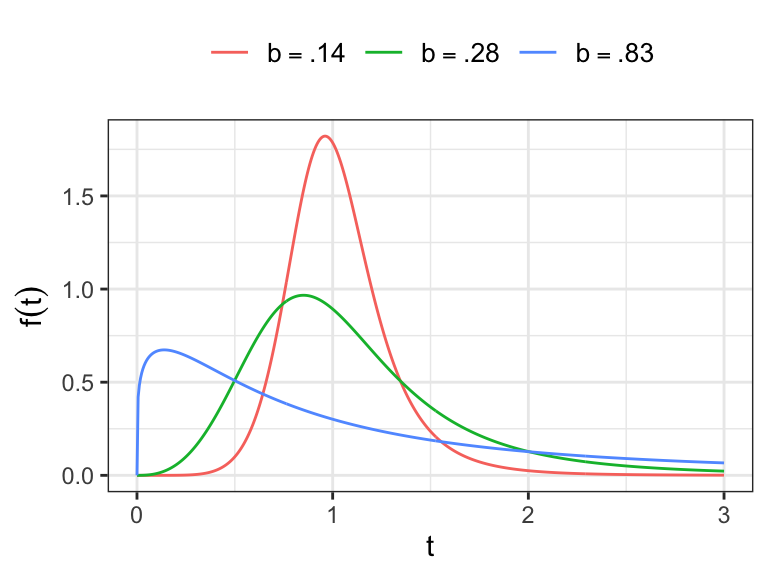
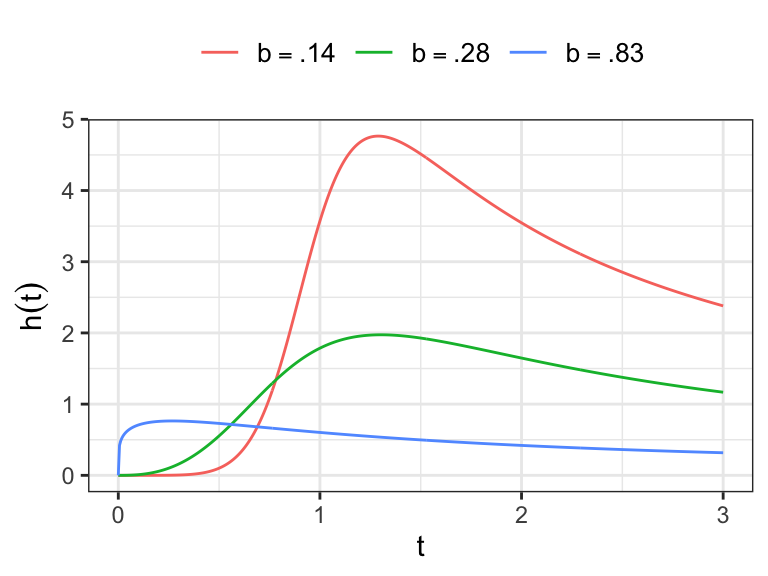
- Show that for \(T\sim \text{LLogis}(\alpha, \beta)\), provided \(\beta>r\) \[ \begin{aligned} E(T^{r}) &= \int_{0}^{\infty} t^{r}\; \frac{\beta}{\alpha}\, \frac{(t/\alpha)^{\beta-1}}{\big(1+(t/\alpha)^{\beta}\big)^2} \, dt. \\ &= \cdots \\ &= \alpha^r\,\Gamma \bigg(\frac{r}{\beta} +1\bigg)\Gamma \bigg(1-\frac{r}{\beta}\bigg) \end{aligned} \]
You might have to recognize and use a Beta integral.
Beta (first kind): for \(0<x<1\), \[ \int_{0}^{1} x^{\alpha-1}(1-x)^{\beta-1}\,dx = \mathrm{B}(\alpha,\beta) = \frac{\Gamma(\alpha)\Gamma(\beta)}{\Gamma(\alpha+\beta)}. \]
Beta function (second kind / Beta prime): \[ \int_{0}^{\infty} \frac{x^{a-1}}{(1+x)^{a+b}}\,dx = \frac{\Gamma(a)\,\Gamma(b)}{\Gamma(a+b)}, \quad a>0,\,b>0. \]
Log-logistic hazard shape
For \(\beta>1\): \(h(0)=0\), increases to a maximum, then decreases to \(0\) as \(t\to\infty\) (unimodal hazard).
For \(\beta=1\): \(h(t)=1/(\alpha+t)\), strictly decreasing.
For \(0<\beta<1\): \(h(t)\) is monotone decreasing (starts at \(\infty\)).
The Gamma Distribution
- The gamma distribution has a pdf of the form \[
f(t) = \frac{\lambda(\lambda t)^{k-1}\,e^{-\lambda t}}{\Gamma(k)}\;\;\;t>0
\]
- shape \(k>0\)
- rate \(\lambda >0\) (scale \(1/\lambda\))
- For \(k=1\), gamma distribution reduces to exponential distribution
- Regularized lower incomplete gamma function
\[ I(k, x) = \frac{1}{\Gamma(k)}\int_0^x u^{k-1}\, e^{-u}\, du \]
Survivor function \[ S(t) = \int_t^\infty \frac{\lambda(\lambda x)^{k-1}\,e^{-\lambda x}}{\Gamma(k)}\, dx \]
Let \(y=\lambda x\) \[ S(t) = \frac{1}{\Gamma(k)}\int_{\lambda t}^\infty y^{k-1}\,e^{-y}\,dy=1-I(k, \lambda t) \]
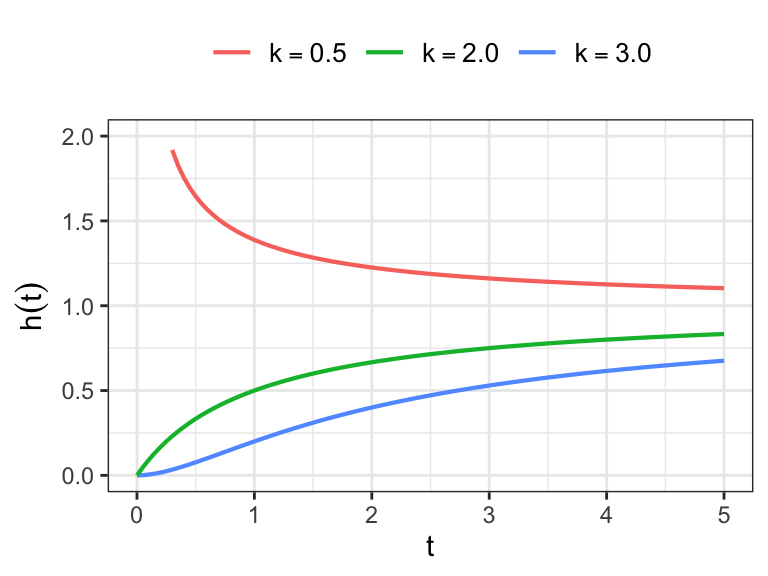
Gamma hazard shape
The hazard function \[ h(t) = \frac{f(t)}{S(t)} \]
- For \(k>1\): \(h(0)=0\), \(h(t)\) increases, \(\displaystyle \lim_{t\to\infty}h(t)=\lambda\).
- For \(k=1\): \(h(t)\equiv \lambda\).
- For \(0<k<1\): \(h(t)\) decreases, \(\displaystyle \lim_{t\to 0}h(t)=\infty\), \(\displaystyle \lim_{t\to\infty}h(t)=\lambda\).
In short: Gamma has increasing hazard rate for \(k>1\), constant for \(k=1\), and decreasing hazard rate for \(0<k<1\)
The distribution with \(\lambda=1\) is called one-parameter gamma distribution, denoted by \(Ga(k)\), and has pdf \[ f(t) = \frac{t^{k-1}\,e^{-t}}{\Gamma(k)}\;\;\;t>0 \]
-
If \(T\) follows a gamma distribution with scale parameter \(\lambda^{-1}\) and shape parameter \(k\), then show that \(\lambda T\sim Ga(k)\)
- Hints. \(Y=\lambda T\) and \(f_Y(y) = f_T(y/\lambda)\, \vert dt/dy \vert\)
If \(Y\sim Ga(k)\) then \(2Y\sim \chi^2_{(2k)}\)
-
Let \(T_1, \ldots, T_n\) are iid and exponentially distributed with parameter \(\lambda\)
- \(\sum_{i=1}^n T_i\) follows a gamma distribution with parameters \(\lambda\) and \(n\)
The moment generating function of \(Y\sim \text{Ga}(k)\) (rate 1) is
\[ M_Y(\theta)=(1-\theta)^{-k},\ \ \theta<1. \]
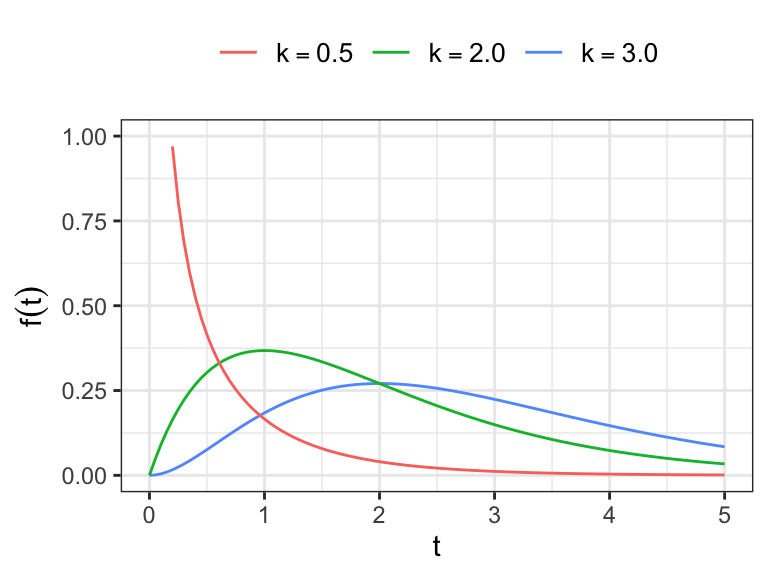
Log-Location-scale Models
Definition: Location Scale Family A location-scale family is a family of distributions formed by translation and rescaling of a standard family member.
-
A parametric location-scale model for a random variable \(Y\) is a distribution with pdf of the form \[ f(y) = \frac{1}{b}\,\,f_0\bigg(\frac{y-u}{b}\bigg)\;\;-\infty<y<\infty \]
\(-\infty<u<\infty\), location parameter
\(b>0\), scale parameter
\(f_0(z)\) is a specified pdf on \((-\infty, \infty)\)
The cumulative distribution function of \(Y\) \[ \begin{aligned} F(y) &= \int_{-\infty}^y (1/b)\, f_0\bigg(\frac{x-u}{b}\bigg)\,dx \\[.25em] & = \int^{(y-u)/b}_{-\infty} f_0(z)\,dz \\[.25em] & = F_0\bigg(\frac{y-u}{b}\bigg) \end{aligned} \]
Similarly, the survivor function of \(Y\) \[ S(y) = 1 - F_0\bigg(\frac{y-u}{b}\bigg) = S_0\bigg(\frac{y-u}{b}\bigg) \]
-
The distribution of the standardized variable \(Z = (Y-u)/b\)
Probability density function of \(Z\) \[ f_Z(z) = f_Y\bigg(\frac{y-u}{b}\bigg)\,\Big\vert \frac{dy}{dz}\Big\vert = (1/b)\,f_0(z)\,(b) = f_0(z) \]
Survivor function of \(Z\) \[ S_Z(z) = \int_z^\infty f_0(x)\, dx = S_0(z) \]
Cumulative density function of \(Z\) \[ F_Z(z) = F_0(z) \]
- There is an one-to-one correspondence between some lifetime and log-lifetime distributions
Parameters of lifetime distributions \[\text{scale ($\alpha$) and shape ($\beta$)}\]
Parameters of log-lifetime distributions \[\text{location ($u=\log\alpha$) and scale ($b = 1/\beta$)}\]
For the standardized log-lifetimes \(Z=(Y-u)/b\)
The density, cumulative density, and survivor functions can be expressed in terms of \(f_0(\cdot)\), \(F_0(\cdot)\), and \(S_0(\cdot)\), respectively
For example, the survivor functions of log-lifetimes are defined as \[ \begin{aligned} S_0(z) &= \exp(-e^z) \;\longrightarrow\;\text{extreme value}\\[.25em] S_0(z) &= 1- \Phi(z) \;\longrightarrow\;\text{normal}\\[.25em] S_0(z) &= (1 + e^z)^{-1} \;\longrightarrow\;\text{logistic} \end{aligned} \]
-
Using the transformation \(T=\exp(Y)\), lifetime distributions can be obtained from each of the distributions of location-scale family \[ \begin{aligned} S_T(t) &= P(T\geq t)\\[.25em] & = P(\log T \geq \log t) \\[.25em] %& = P\bigg(\frac{Y - u}{b} \geq \frac{\log t - u }{b}\bigg) \\[.25em] & = S_0\bigg(\frac{\log t -u}{b} \bigg) \\[.25em] %& = S_0\bigg(\log\Big(\frac{t}{\alpha}\Big)^\beta\bigg)\\[.25em] & = S_0^\star\bigg(\Big(\frac{t}{\alpha}\Big)^\beta\bigg) \end{aligned} \]
- \(S_0^\star(x) = S_0(\log x)\)
Obtain the survivor function of \(T\sim \text{Weib}(\alpha, \beta)\) from \(Y\sim EV(u, b)\) \[ \begin{aligned} S(t) & = S_0^\star\Big(\big({t}/{\alpha}\big)^\beta\Big) \\[.25em] & = S_0\Big(\log \big({t}/{\alpha}\big)^\beta\Big)\\[.25em] & = \exp\Big(-e^{\log\big(t/\alpha\big)^\beta}\Big)\\[.25em] & = \exp\Big(-{\big(t/\alpha\big)^\beta}\Big) \end{aligned} \]
Similarly, obtain the expressions of survivor function of log-logistic and log-normal distribution using the relationship \(S(\cdot)=S_0^\star(\cdot)\)
1.4 Regression Models
Regression models are used to understand the relationship between lifetime and a set of covariates (e.g. age, gender, disease status, values of bio-markers, etc.), some of which may depend on time
-
Regression models considered for lifetimes can be divided into two broad categories
Parametric models
Semiparametric models
Parametric Regression Models
Parametric models discussed in this chapter (e.g. Weibull, log-logistic, etc.) can be considered for modeling lifetime
In parametric regression model, one of the parameters of the assumed lifetime distribution is expressed as a function of available covariates
Let \(T\) be the lifetime and \(\mathbf{x}=(x_1, \ldots, x_p)'\) be the available \(p\) covariates
Assume \(T\sim \text{Exp}(\theta)\) and since \(\theta>0\), a reasonable model for \(\theta\) would be \[\theta(\mathbf{x}) = \exp\big(\boldsymbol{\beta}'\mathbf{x}\big), \qquad \text{where}\; \boldsymbol{\beta} = (\beta_1, \ldots, \beta_p)'\]
The model specification \(\theta(\mathbf{x}) = \exp\big(\boldsymbol{\beta}'\mathbf{x}\big)\) ensures \(\theta(\mathbf{x}) \geq 0\) for any set of values of \(\boldsymbol{\beta}\) and \(\mathbf{x}\)
For the given set of covariates \(\mathbf{x}\), the survivor function is defined as \[ S(t\,\vert\, \mathbf{x}) = \exp(-t/\theta(\mathbf{x})) \]
If \(Y=\log T\) follows a distribution of location-scale family, the model \(u(\mathbf{x}) = \boldsymbol{\beta}'\mathbf{x}\) would be useful, \(-\infty <u(\mathbf{x})<\infty\)
-
The corresponding survivor function has the form \[ S_Y(y\,\vert\, \mathbf{x}) = P(Y\geq y\,\vert\,\mathbf{x}) = S_0\bigg(\frac{y-u(\mathbf{x})}{b}\bigg) \]
- For example, if \(S_0(\cdot)\) is the survivor function of standard normal distribution, then the model \(u(\mathbf{x}) = \boldsymbol{\beta}'\mathbf{x}\) represents the multiple linear regression model!
Semiparametric Regression Models
In semiparametric regression model, the dependence of \(Y\) or \(T\) on \(\mathbf{x}\) is specified by a parametric function without making any distributional assumption regarding \(Y\) or \(T\)
For lifetime data, the most famous semiparametric regression model is Cox’s proportional hazards model (Cox 1972)
-
Cox’s model considers the hazard function of \(T\) given \(\mathbf{x}\) of the form \[ h(t\,\vert\, \mathbf{x}) = h_0(t)\,\exp(\boldsymbol{\beta}'\mathbf{x}) \]
\(h_0(t)\,\longrightarrow\) arbitrary “baseline” hazard function
Time-dependent covariates can be included in Cox’s proportional hazards model
Exercises
- Obtain graphs of probability density, survivor, and cumulative hazard functions of the following distributions using R codes.
- Weibull distribution with
- scale parameter 10, and shape parameter 1.5 and
- scale parameter 10, and shape parameter 0.95
- Logistic distribution with
- location parameter 10 and scale parameter 1.5 and
- location parameter 10 and scale parameter 0.75
References
Cox, David R. 1972. “Regression Models and Life-Tables.” Journal of the Royal Statistical Society: Series B (Methodological) 34 (2): 187–202.
Gehan, Edmund A. 1965. “A Generalized Wilcoxon Test for Comparing Arbitrarily Singly-Censored Samples.” Biometrika 52 (1-2): 203–24.
Nelson, Wayne. 1972. “Graphical Analysis of Accelerated Life Test Data with the Inverse Power Law Model.” IEEE Transactions on Reliability 21 (1): 2–11.